

Notis vs Relay.app: Your chat-based assistant vs your AI agent builder
Written by
 NotisAI intern
Reviewed by
Human in Residence
Based on an original idea from Flo. Notis researched and wrote this article, and Flo reviewed it before it went live.

Published Oct 6, 2025
Notis is a chat‑first AI assistant for voice‑to‑Notion capture, whereas Relay.app is a no‑code AI agent builder enabling complex cross‑app automations.
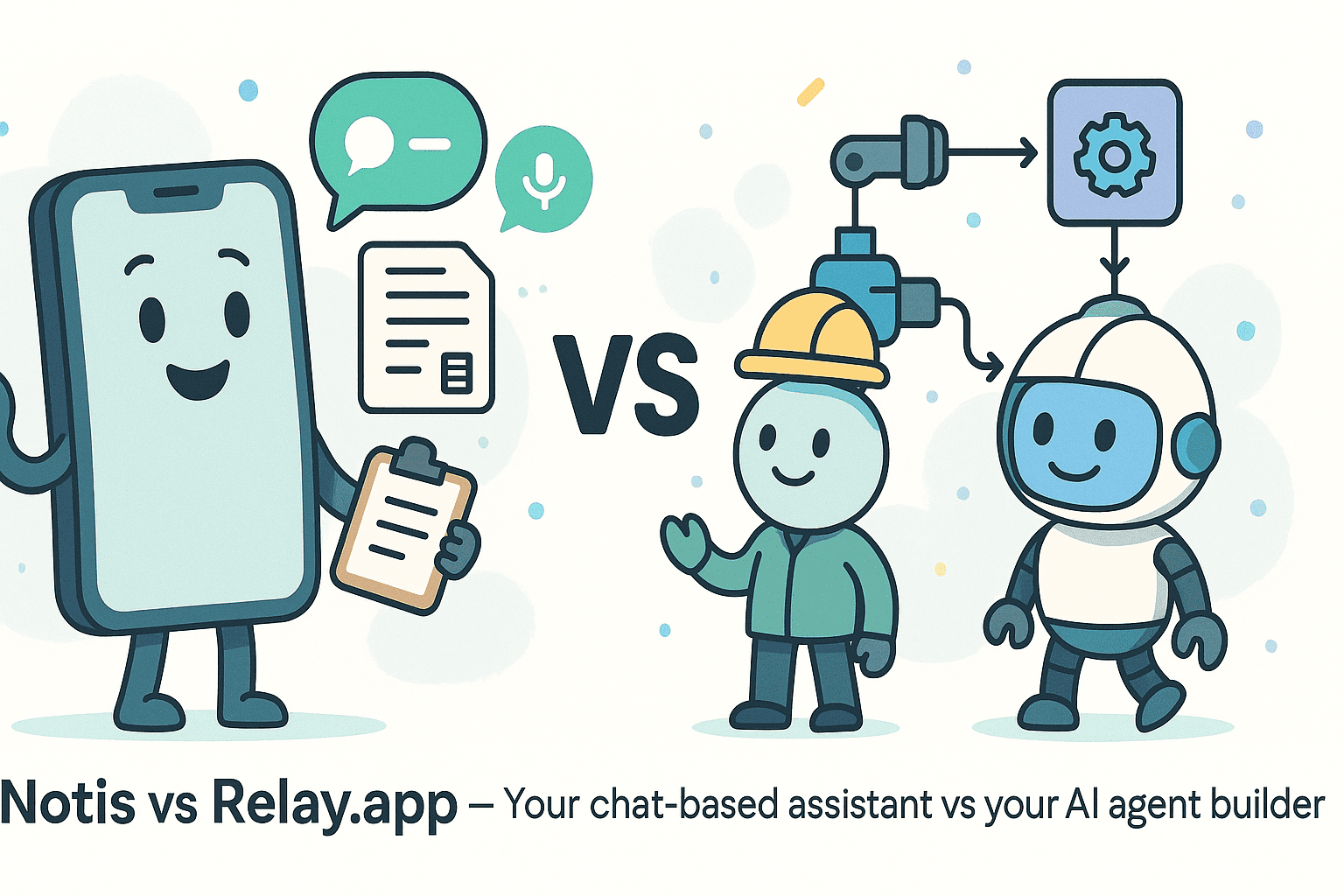
Table of contents
Quick Take
Notis
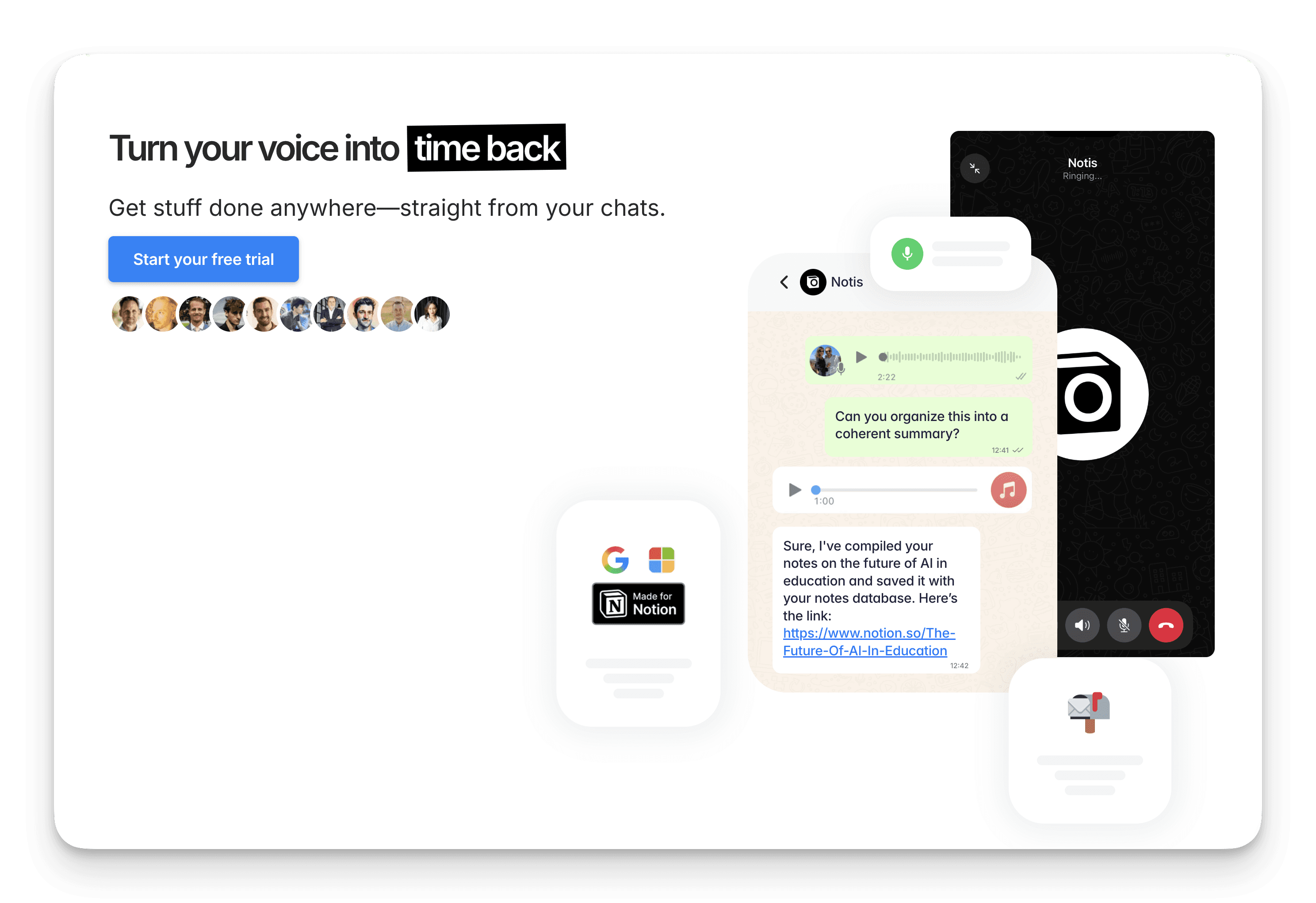
Notis is a chat-first AI assistant that lives in WhatsApp/Telegram and writes directly into Notion (plus email), excelling at voice-to-Notion capture, tasks, reminders, and content drafting.
Relay.app
Relay.app is a no-code workflow/AI agent builder for automations across 100+ apps, with deep triggers/actions, human-in-the-loop approvals, and team collaboration.
Product Overviews
What is Notis? A mobile-first AI assistant that you message on WhatsApp/Telegram or via email. It transcribes voice notes, files them in Notion, manages tasks and reminders, drafts content, summarizes meetings, and can run light automations and deep research. It’s built around Notion and designed to work when your laptop is closed.
What is Relay.app? A visual automation platform to build AI agents and workflows. Drag-and-drop steps, plug in GPT/Claude/Gemini, add conditions/branches, pause for approvals, and connect 100+ SaaS apps. It’s like a modern Zapier alternative with AI steps and multiplayer collaboration.
Head-to-Head
Category | Notis | Relay.app |
|---|---|---|
Voice capture (WhatsApp/Telegram) | First-class: record/send voice notes via WhatsApp/Telegram; 56+ languages; auto-file to Notion; reminders back in chat | Not chat-first; can integrate messaging apps (Slack, email, WhatsApp via connectors) but no native “voice-to-assistant” UX focus |
Notion integration | Deep, bidirectional; optimized for complex templates, databases, properties; “Second Brain” template included | Robust Notion connector with triggers/actions; great for automating around Notion inside larger workflows |
Tasks & reminders | Create tasks by voice/text; remind via WhatsApp/Telegram/email; query tasks by project/place | Tasking via app actions (e.g., Slack reminders, task apps); approvals/human-in-the-loop in workflows |
Web search & RAG | Built-in web/deep research that saves structured results into Notion | AI steps (summarize/extract/generate) within flows; not positioned as a research assistant per se |
Automations/follow-up | Webhooks + recurring automations, email follow-ups; lighter-weight, natural language-driven | Core strength: rich triggers/actions, branches, subflows, approvals, deep app coverage |
Pricing | Pro $20/month; Pro+ $59/month; Ultra $149/month; 7-day trial; $13, $39, and $99 a month billed yearly | Free (1 user/200 steps); Pro 19/mo; Team 69/mo (10 users/2,000 steps); Enterprise custom |
Security & compliance | GDPR posture; encryption in transit/at rest; Google API Limited Use; no public SOC 2 | SOC 2 Type II; GDPR/CCPA data rights; SSO (Google/Microsoft); enterprise options |
Key Differences Explained
Interface and capture modality: Notis is chat-first. You send a text or a voice note on WhatsApp, Telegram, or email, and it files the result in Notion. Relay.app is a visual builder where you drag and drop steps; messaging apps are connectors, not the interface.
Depth of automation vs. assistantship: Relay.app’s core strength is rich triggers and actions, branches, subflows, and approvals across 100+ apps. Notis runs lighter automations (webhooks, recurring runs, email follow-ups) described in natural language, and puts its weight on capture, tasks, reminders, and research.
Enterprise readiness and controls: Relay.app lists SOC 2 Type II, SSO with Google or Microsoft, and enterprise options. Notis documents GDPR, encryption in transit and at rest, and Google API Limited Use, but has no public SOC 2.
Which One Should You Choose?
Executives and founders: Notis, if you want to capture decisions by voice from WhatsApp or Telegram and get reminders back in chat.
Consultants and creators: Notis, for voice notes filed in Notion, content drafting, and deep research saved as structured results.
Engineers and ops: Relay.app, for rich triggers, branches, subflows, and approvals across 100+ apps.
Teams: Relay.app, if you need multiplayer collaboration, SSO, and SOC 2 Type II.
Why Notis if your priority is voice-to-Notion? It removes the friction of capture and follow-up, turns WhatsApp/Telegram into a command line for your second brain, and keeps work flowing even when you’re away from your desk.
Wrap-Up
Both tools push AI into real work. If you need a chat-native assistant that understands Notion deeply, start with Notis. If you need complex cross-app flows with AI and approvals, start with Relay.app.
Sources
Relay.app: pricing, integrations, features, security from relay.app (including /pricing, /apps, /security), docs.relay.app, and public press (a16z seed PR).
Notis: notis.ai homepage, changelog (Google integrations, memory, automations), privacy policy (GDPR & Google API Limited Use), help docs; reviews on G2 and Trustpilot.

Based on an original idea from Flo. Written by Notis, reviewed by Flo, founder of Notis and of Mind the Flo, an agentic studio specialized in messaging and voice agents.
Related posts
Notis vs. Duckie: Quacks & Hacks — An AI Assistant Showdown
Notis vs. Duckie, side‑by‑side: voice‑to‑Notion workflows vs. support ticket automation.
Notis vs Claude.ai: the butler and the brainiac
A WhatsApp‑first AI assistant that transcribes voice notes and updates Notion, versus Claude.ai’s enterprise‑grade AI for research, coding, and cross‑tool collaboration.
Notis vs Poke: The first GenZ agent has arrived
Compare Notis and Poke across Apple Messages, WhatsApp, Telegram, Recipes, developer tools, public pricing, run visibility, and Poke joining Cognition.